
Across the Bali Process region, the interplay between disasters and migration is becoming increasingly complex, reflecting the cumulative impact of environmental change, social vulnerability, and economic uncertainty. Disasters—both sudden-onset events such as floods and cyclones, and slow-onset processes like drought, salinisation, and sea-level rise—are altering traditional patterns of movement and challenging established distinctions between voluntary and forced migration.
Published by the Regional Support Office of the Bali Process on People Smuggling, Trafficking in Persons and Related Transnational Crime (RSO), in partnership with the Migration Hub of the Australian National University (ANU), Literature Mapping: Impact of Natural and Humanitarian Disasters on Irregular Migration, and Irregular Labour Migration in the Bali Process Region, explores this complex intersection between natural and humanitarian disasters, irregular migration, and irregular labour mobility across the Bali Process region.
Drawing on 179 academic and grey literature sources published between 2019 and 2024, the report illustrates how the accelerating impacts of climate change and environmental degradation exacerbate vulnerabilities and influence patterns of displacement and migration.
Through its analysis of climate-induced displacement, legal and policy gaps, the absence of safe and accessible migration pathways, and the evolving nature of labour exploitation, the study offers a nuanced understanding of how economic pressures, livelihood insecurity, and systemic constraints converge to shape irregular mobility.
Commissioned and funded by the Australian Government Department of Home Affairs, the study aims to support and advances evidence-informed policymaking, and promote coordinated regional action on migration challenges.
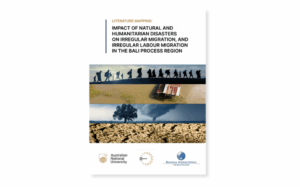
The report identifies two interrelated thematic areas through which disasters shape irregular migration: climate-induced displacement and irregular labour migration.
The first theme examines how climate change and environmental degradation are reshaping mobility patterns. Climate-induced migration is often localised and temporary, emerging as both an adaptation strategy and a consequence of constrained livelihoods.
In the absence of legal definitions or recognised protection frameworks for climate-affected populations, many displaced persons remain beyond the scope of formal assistance or lawful migration pathways. Examples such as Fiji’s planned relocation frameworks demonstrate innovative regional responses, though the report notes the need for further evaluation of their long-term sustainability.
The second theme explores the systemic factors driving irregular labour migration, including restrictive immigration regimes, exploitative industries, and limited access to regulated migration channels. In such environments, migrants often depend on informal brokers or unverified recruitment networks, exposing them to trafficking, forced labour, or deceptive employment practices. The analysis also points to the emergence of new exploitative markets, such as scam-based operations, which reflect the evolving intersection between technology, labour, and irregular migration.
Throughout both themes, the report highlights the importance of intersectionality, recognising how gender, disability, age, and socio-economic inequality intensify vulnerability. It calls for inclusive, fair, and rights-based labour mobility systems that protect those most at risk.
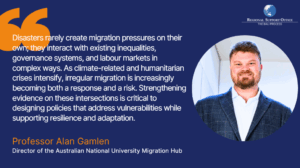
Reflecting on the findings, Professor Alan Gamlen, Director of the ANU Migration Hub and co-author of the report, emphasised that understanding the relationship between disasters and irregular migration requires moving beyond linear or crisis-driven models:
Positioned at the centre of the report is a set of forward-looking research and policy priorities that can guide Bali Process Member States in strengthening evidence-informed approaches to disaster-related mobility and irregular migration. These priorities include:
- Localised analysis of migration patterns: Advancing detailed, context-specific research on climate-related mobility in highly vulnerable regions, particularly the Pacific, with attention to demographic shifts, mobility options, and the socioeconomic pressures shaping movement.
- Intersection of climate mobility and exploitation: Examining how climate-driven mobility intersects with trafficking, forced labour, and other forms of exploitation, and assessing how accessible and safe migration pathways can reduce these risks in disaster settings.
- Legal pathways for climate mobility: Exploring options for cross-border mobility frameworks for climate-affected populations, addressing the legal and policy gaps that currently compel many to rely on irregular channels.
- Labour market dynamics and irregular migration: Investigating how demographic change and labour shortages in sectors such as healthcare and agriculture, influence irregular labour migration within Bali Process Member States.
- Effectiveness of border deterrence policies: Analysing whether border control measures reduce irregular migration or simply displace movement toward more dangerous routes and comparing the impacts of rights-based approaches with deterrence strategies.
- Emergence of multi-directional smuggling: Studying the drivers behind increasingly multi-directional smuggling flows, including unauthorised returns, and understanding how restrictive return and reintegration policies shape these patterns.
The Literature Mapping report reaffirms the importance of understanding migration within the broader context of environmental change, economic pressures, and human security. It serves as a reminder that effective responses to irregular migration must go beyond border management to address the root causes that shape people’s decisions to move.
Download the full report here.
For more information, please contact info@rso.baliprocess.net.