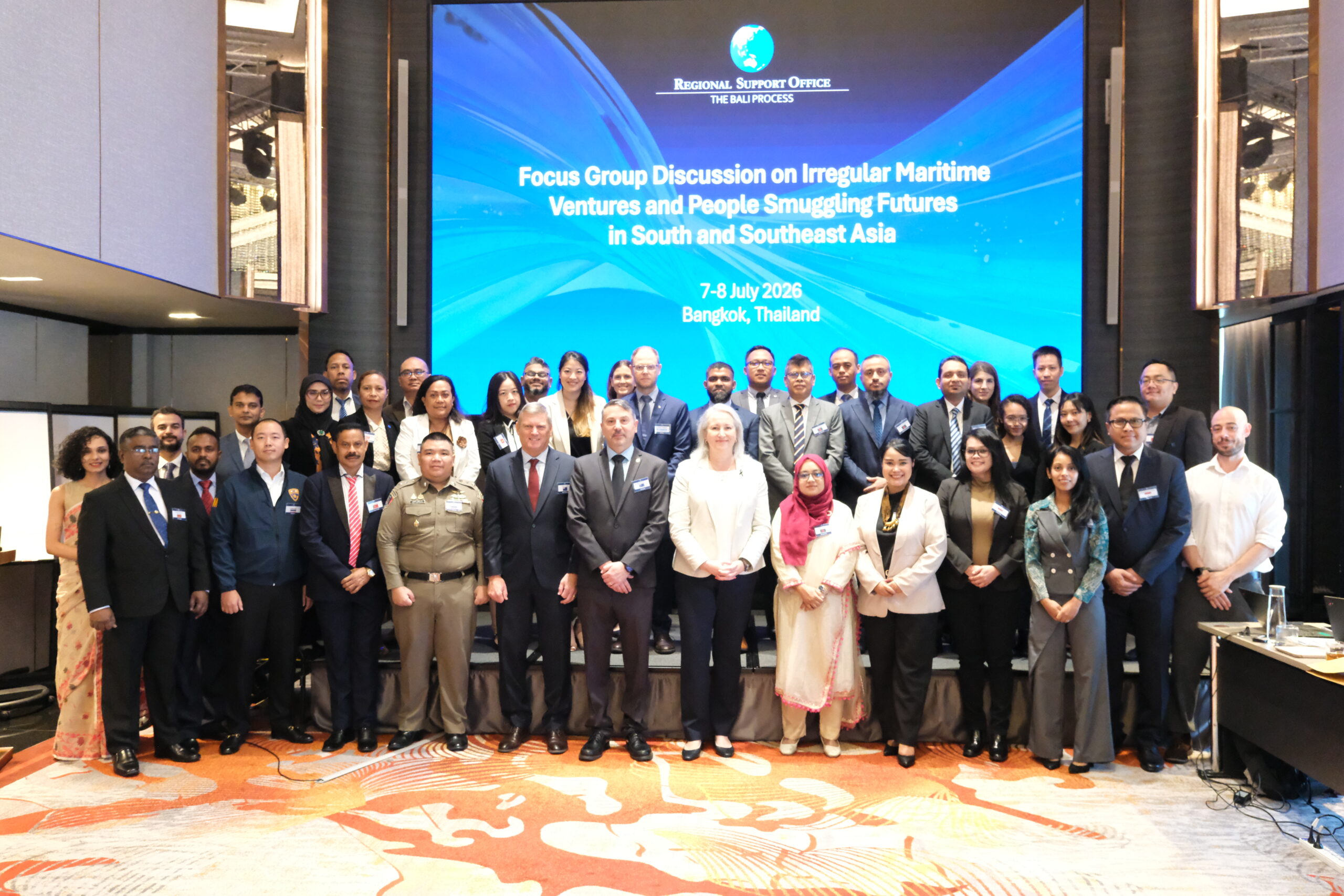

7 – 8 July 2026 • Bangkok, Thailand
Maritime people smuggling networks across South and Southeast Asia are evolving rapidly, exploiting new technologies, shifting routes and increasingly blurred lines between regular and irregular travels to move people undetected. For Bali Process Member States, keeping pace with these changes is central to promoting safe and orderly migration and disrupting criminal networks.

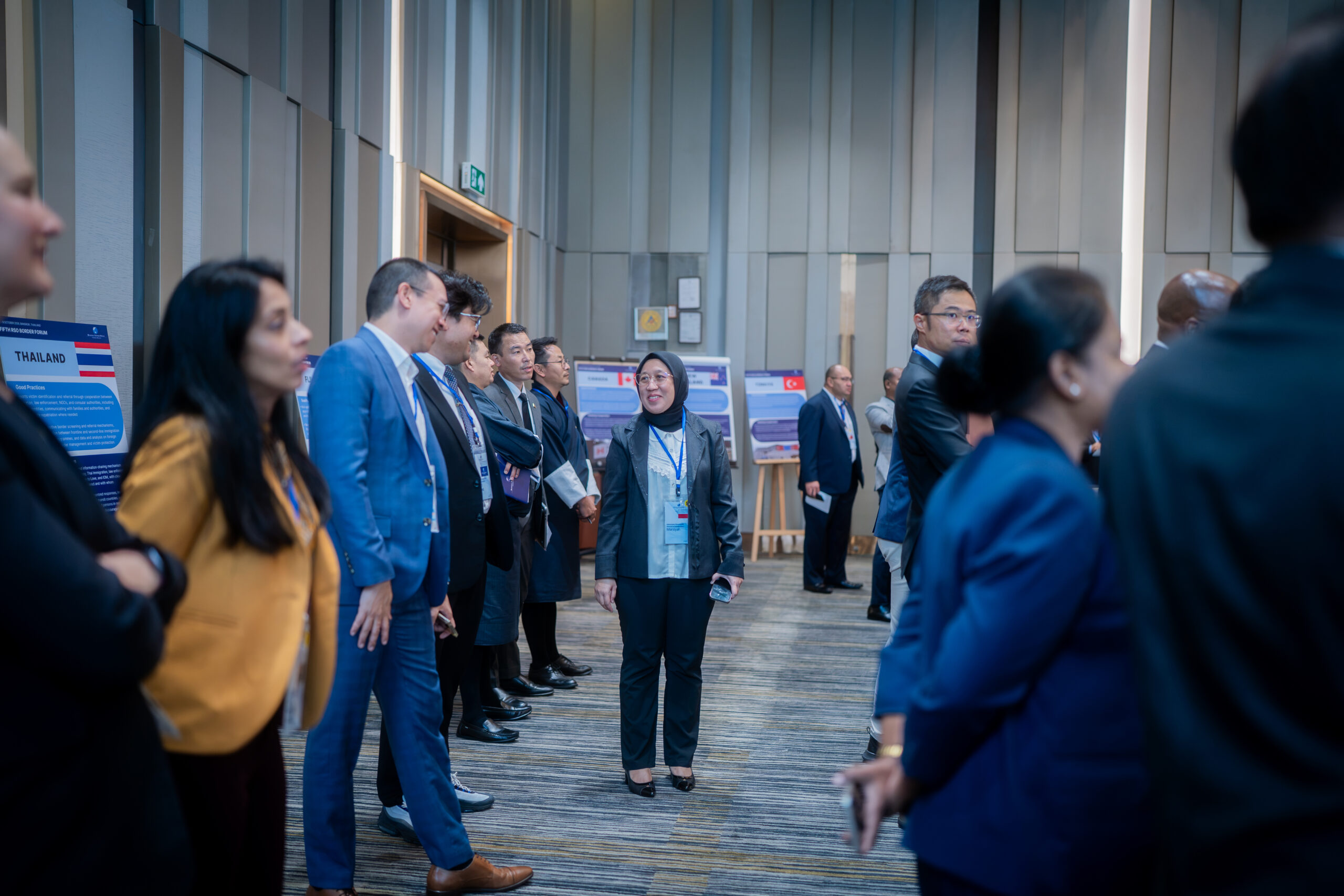
To strengthen the region’s collective response, the Regional Support Office of the Bali Process (RSO) convened a two-day Focus Group Discussion (FGD) on Irregular Maritime Ventures and People Smuggling Futures in South and Southeast Asia. The FGD brought together government officials from Australia, Bangladesh, Indonesia, Malaysia, Sri Lanka, Thailand, Timor-Leste and Viet Nam, alongside representatives from the International Organization for Migration (IOM), the United Nations Office on Drugs and Crime (UNODC), and the United Nations High Commissioner for Refugees (UNHCR).
The discussion forms part of the RSO’s role as a platform for practical cooperation and knowledge exchange and builds on the RSO’s ongoing efforts to support Members in countering people smuggling. Insights from the Regional Workshop on Disrupting the Logistics of People Smuggling held in November 2025 provided the foundation for the FGD, enabling delegates to move beyond a broad focus on logistics as a vulnerability and engage in a more detailed examination of maritime people smuggling networks and emerging trends across the region.
Technology emerged as one of the most significant forces reshaping the maritime people smuggling business model. Delegates highlighted the growing use of social media and encrypted messaging applications, which let smugglers advertise routes and prices to a wide audience, recruit and coordinate, and organise journeys while evading the kind of interception possible with conventional phone or radio communications.
An expert session examined how further emerging technologies are accelerating this shift— satellite internet is enabling smuggling networks to coordinate with vessels far from shore and beyond the reach of conventional monitoring; artificial intelligence (AI) is lowering the skill and cost needed to produce convincing fraudulent documents and translate recruitment material across languages; and cryptocurrency and digital payment systems are giving facilitators new ways to collect and move proceeds that are harder to trace than cash or bank transfers. Together, these developments are creating new challenges for law enforcement agencies across the region.
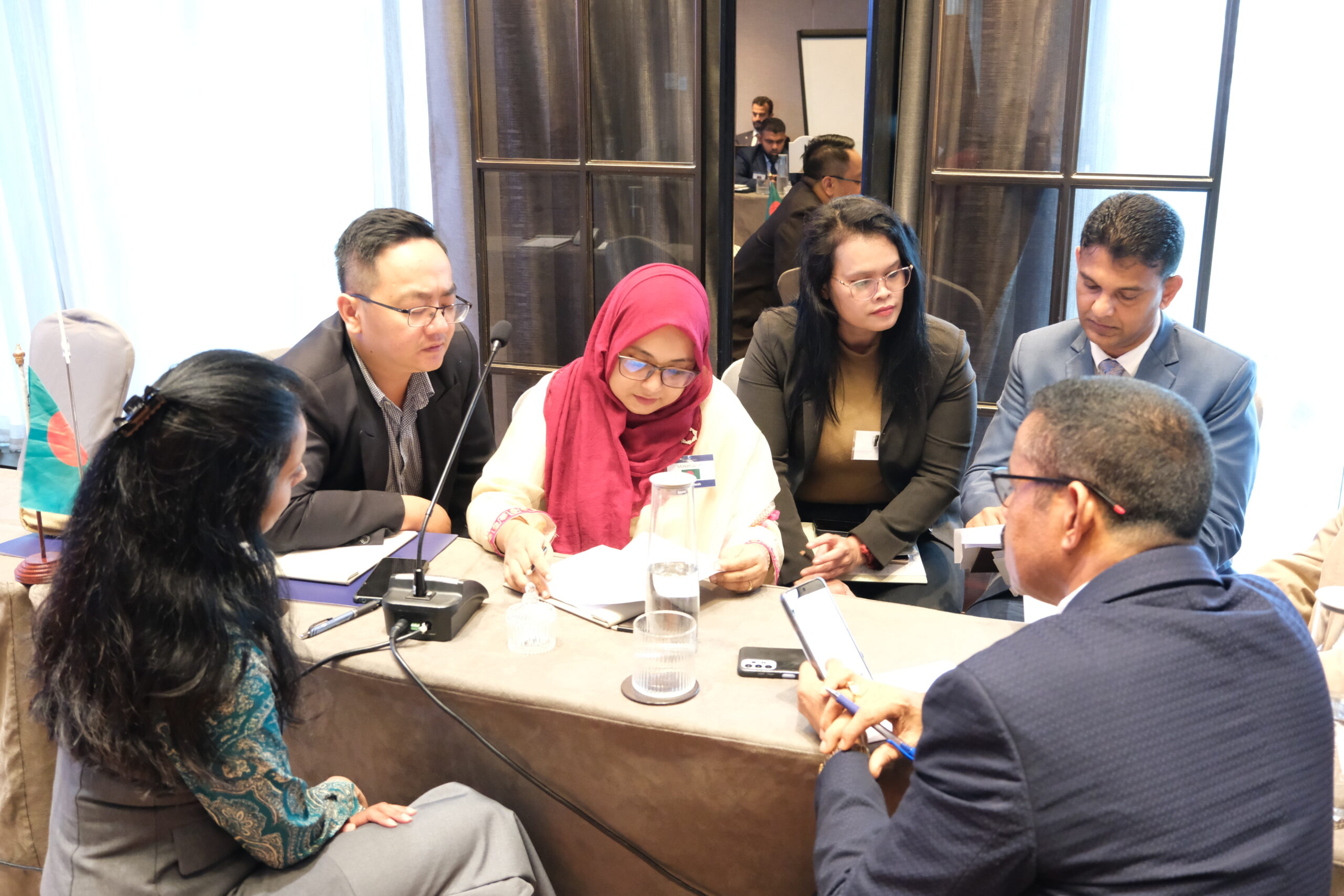
Throughout the sessions, delegates exchanged national experiences on evolving smuggling routes and criminal methodologies, sharing observations on continued irregular maritime departures across the Bay of Bengal and highlighting changing movement patterns, including individuals entering countries through regular channels before undertaking irregular onward travel. They also discussed how legitimate travel pathways can be exploited as part of broader smuggling operations, illustrating the increasingly complex nature of transnational migration movements.
Delegates also exchanged experiences on financial investigations as a means of disrupting organised criminal networks. There were examples of using financial investigations to identify high-level organisers, while discussing the increasing complexity of money laundering methods linked to people smuggling. These discussions reinforced the value of complementing maritime enforcement activities with financial intelligence, digital investigations and open-source intelligence capabilities.
Resource and capability challenges were another common theme. Delegates noted that resource constraints can affect maritime monitoring and surveillance, particularly across vast maritime areas, and identified opportunities to strengthen capabilities in digital and financial investigations. This also reflects a growing regional recognition that effective disruption increasingly depends on integrating financial investigations, digital forensics, online investigations and rapid cross-border intelligence sharing into routine operational practice.
Throughout the FGD, delegates emphasised that effective responses depend not only on national capabilities but also on timely information sharing and trusted partnerships. They identified opportunities to strengthen cooperation through existing regional mechanisms, improve interoperability between agencies, and share expertise on emerging technologies and investigative practices.
Ben Reeves, the RSO Co-Manager (Australia), reaffirmed the importance of information sharing and practical cooperation in addressing transnational crime. “Information sharing is often critical to disruption. Smuggling networks operate across jurisdictions, adapt quickly, and exploit gaps between national systems. By working with shared purpose, and through building trusted operational relationships, we learn how to share information effectively. This places us in a strong position to disrupt these networks and protect vulnerable people.”
An outcome report from the FGD will feed into future RSO regional programming and contribute to ongoing efforts, to strengthen cooperation against maritime people smuggling across South and Southeast Asia. These efforts will continue at the RSO’s upcoming Regional Dialogue to Strengthen Regional Responses to the Smuggling of Migrants by Land, Sea and Air, to be held in Kuala Lumpur, Malaysia on 17-18 September 2026, which will build on the FGD’s findings.
The Regional Dialogue will provide a platform for Member States to exchange operational experiences and explore practical approaches to strengthening legal and operational responses to people smuggling, in line with the objectives of the United Nations’ Protocol against the Smuggling of Migrants by Land, Sea, and Air (SOM Protocol). Together, these efforts reflect the Bali Process’s broader goal of protecting vulnerable people while disrupting the networks that exploit them.